How Much Does a Leather Jacket Cost? A Real Buyers Guide to Pricing
You want to buy a leather jacket. You open a few tabs, see prices ranging from $80 to $2,000, and suddenly feel completely lost. That confusion is completely valid. The leather jacket market spans a wild range of quality tiers, materials, and craftsmanship levels — and the price tag alone rarely tells the full story.
This guide cuts through the noise. By the end, you will know exactly what drives leather jacket pricing, where each price tier lands in terms of real-world quality, and how to spend your money wisely — whether you are shopping for your first jacket or your forever piece.
What Actually Determines the Cost of a Leather Jacket
Before you judge any price tag, you need to understand what goes into building one. A leather jacket is not a single product. It is a collection of decisions — material, construction, design, and finishing — that compound into a final number.
The Type of Leather Changes Everything
Leather is not one material. It is a spectrum. At the top sits full-grain leather, which craftsmen cut from the outermost layer of the hide without sanding or buffing. It retains the natural grain, the texture, the character. That natural structure makes it the most durable leather available, and also the most expensive.
Step down one level and you find top-grain leather. Manufacturers sand away the surface imperfections and produce a cleaner, more uniform finish. It looks sharp and costs less than full-grain, but it sacrifices some of that raw, natural character over time.
Further down the ladder sits genuine leather — a term that sounds premium but simply means real leather scraps bonded or pressed together. Below that comes bonded leather, which uses adhesive to hold leather fragments in place. At the bottom of the quality spectrum, faux or vegan leather uses synthetic materials like polyurethane or PVC. Durable for a season or two, but nowhere close to the longevity of real hide.
Full-grain leather jackets carry the highest price because no other leather type matches their strength, aging quality, or texture.
Craftsmanship Costs Time — and Time Costs Money
A handcrafted jacket made by a single artisan from start to finish takes far more labor hours than a jacket rolling off a production line in bulk. That extra time shows up in tighter stitching, cleaner seam work, better alignment of panels, and hardware that actually sits flush and secure.
Mass-produced jackets cut those hours deliberately. The savings pass partly to you in a lower price. But shortcuts show — in uneven seams, misaligned zippers, hardware that loosens quickly, and linings that feel thin and cheap.
Design Details Add Up Fast
A plain biker jacket with a single front zip and two pockets costs far less to produce than a jacket loaded with buckle straps, embroidered panels, a detachable hood, interior pockets, and spike detailing. Each added feature requires extra materials and extra hands-on labor.
The lining matters too. A thin polyester lining keeps production costs low. A quilted, fleece-lined, or satin lining requires better materials and more careful installation — and that shows up in the retail price.
Breaking Down the Leather Jacket Price Ranges
Now for the number you actually came here for. Here is what each price tier realistically delivers.
Under $200 — Budget Territory
Jackets in this range typically use genuine leather, bonded leather, or faux leather. They look the part in photos and sometimes in person. But wear one for a season and you notice the signs: peeling edges, loosening stitches, hardware that feels hollow, and a lining that pills or tears.
These jackets work as a fashion piece for occasional wear. Do not expect them to last more than a couple of years with regular use.
$300 to $800 — The Mid-Range Sweet Spot
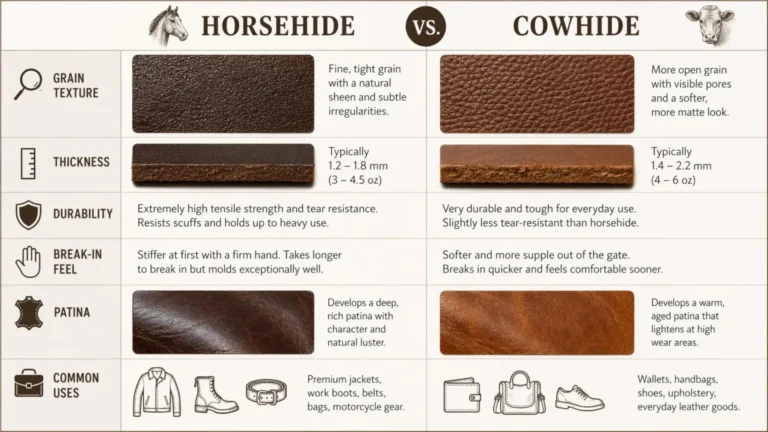
This is where quality starts to feel real. Jackets in this range typically use top-grain leather or quality cowhide. Stitching holds up. Hardware feels solid. The lining breathes and lasts. You get more design variation, better fit construction, and a jacket that genuinely ages well with basic care.
For most buyers, this range hits the ideal balance between investment and return. You spend a meaningful amount once instead of replacing a cheaper jacket every two years.
$800 and Above — Premium and Luxury
At this level, brands charge for full-grain leather, handcrafted construction, and in many cases, exclusive design. Luxury fashion houses add significant brand premium on top of the material cost — sometimes justified, sometimes not.
A $1,200 jacket from a heritage leather brand and a $1,200 jacket from a high-fashion label may use similar materials, but the brand label alone can account for hundreds of dollars of that price. The quality at this tier is genuinely exceptional, but you pay for prestige as well as performance.
Cheap vs. Expensive: What You Actually Lose Going Budget
Spending less feels smart in the moment. But cheap leather jackets carry hidden costs that show up over time.
A low-quality jacket shows wear fast. The surface cracks or peels. Stitching frays at stress points — the collar, the cuffs, the pockets. The zipper pulls start to stick or snag. Within a year or two, the jacket looks dated and tired.
A quality leather jacket, maintained properly, lasts decades. It does not just hold up — it improves. Full-grain leather develops a patina over years of wear, growing richer and more characterful with each season. You pay more upfront, but the cost-per-wear ratio flips completely over time.
Think of a quality leather jacket the way you think of a quality watch or a good pair of boots. It is not a seasonal purchase. It is a wardrobe asset.
Real Leather vs. Faux Leather — Does the Price Difference Matter?
Faux leather jackets start around $50 and can push past $150 for well-constructed versions. They look convincing in photos and sometimes in person. But they do not breathe, they do not age gracefully, and they do not carry the weight and texture that real leather delivers.
Real leather — even at the genuine or top-grain level — feels different. It conforms to your body over time. It handles temperature changes better. It develops character instead of deteriorating.
If you plan to wear a jacket frequently and keep it for years, real leather justifies the higher cost completely. If you need something casual for occasional outings, faux leather at $100 to $150 does the job without a major commitment.
Should You Consider a Custom Leather Jacket?
Custom jackets cost more than off-the-rack options, but they deliver something standard sizing never can — a jacket built for your exact measurements, in the leather you choose, with the details you specify.
For buyers who have struggled with fit issues — narrow shoulders, longer torsos, non-standard proportions — a custom jacket removes the frustration entirely. You also control the leather type, the lining, the hardware finish, and the overall silhouette.
The premium over a comparable ready-made jacket typically runs 20 to 40 percent. For many buyers, that premium pays for itself in fit satisfaction alone.
How to Spot Value Regardless of Price
Here is what to look for when you evaluate any leather jacket, at any price point.
Run your hand across the surface. Real leather has a natural texture — subtle variation, slight give, a smell that synthetic materials cannot replicate. Faux leather feels uniform and slightly plastic.
Check the seams. Tight, even stitching at every join signals quality construction. Loose threads, skipped stitches, or puckered seams around the collar and cuffs suggest rushed production.
Test the hardware. Zippers should pull smoothly and sit flush. Snaps should close firmly. Buckles should feel solid, not hollow or rattly.
Look at the lining. Pull back the collar or hem slightly. A well-made jacket lines the interior cleanly, with seam tape or flat construction. A cheap jacket reveals raw edges and rough finishes on the inside.
When Buying Online, Watch for These Red Flags
A leather jacket listed at $60 on a marketplace site with no brand information is almost certainly not real leather. Even basic genuine leather costs enough to make $60 pricing impossible without cutting every corner.
Look for brands that provide leather type specifics — full-grain, top-grain, cowhide, lambskin — rather than vague terms like “premium leather” or “genuine leather blend.” Legitimate brands name their materials clearly.
Read verified reviews that mention long-term wear, not just first impressions. A jacket that looks great on delivery can look very different after six months of regular use.
The Bottom Line on Leather Jacket Pricing
A leather jacket worth wearing costs at least $300. Below that threshold, compromises in material and construction start showing within months of purchase. The $300 to $800 range delivers genuine quality for most buyers. Above $800, you enter luxury territory where brand prestige factors in alongside material quality.
Real leather beats faux leather for durability, feel, and long-term value. Full-grain beats every other type for longevity. And craftsmanship — that careful, skilled construction — makes the difference between a jacket you replace in two years and one you pass down in thirty.
Spend once. Spend right. A great leather jacket rewards you every single time you put it on.
FAQ — Leather Jacket Pricing Questions Real Shoppers Ask
How much should I spend on a good leather jacket?
For genuine quality, plan to spend between $300 and $800. Jackets in this range use real leather — typically top-grain or cowhide — with solid construction that lasts years. Anything under $200 usually involves significant compromises in material or stitching quality.
Why are some leather jackets so expensive compared to others?
Price differences come down to leather type, craftsmanship, and brand. Full-grain leather costs more to source and work with. Handcrafted construction adds labor hours. Luxury brands also charge a premium for their name. These factors stack up quickly and explain the wide price gap between budget and high-end options.
Is a $100 leather jacket actually real leather?
Most jackets at this price point use bonded leather, faux leather, or heavily processed genuine leather scraps. Real full-grain or top-grain leather costs too much to source for a $100 retail price. Always check the product listing for specific leather type before purchasing.
How do I know if a leather jacket is worth the price?
Check the leather type, stitching quality, hardware, and lining finish. A jacket worth its price uses named leather (cowhide, lambskin, full-grain), has tight even seams, solid zippers, and a clean interior lining. Vague terms like “premium leather” without specifics are a warning sign.

Grayscale Jacket Editorial Team is a group of fashion writers and product researchers who share guides, reviews, and styling tips about jackets and outerwear. Their goal is to help readers choose high-quality, stylish jackets while staying updated with the latest fashion trends.