What Is Full-Grain Leather? The Only Guide You Need
If you have ever shopped for a leather jacket, wallet, or bag, you have likely come across the term “full-grain leather.” It sounds premium. It probably costs more. But what does it actually mean, and why does it matter so much?
This guide breaks it all down. You will learn exactly what full-grain leather is, how it compares to other leather types, and why choosing the right grain can make the difference between a product that lasts a lifetime and one that falls apart in a few years.
What Does “Grain” Mean in Leather?
Before we get into full-grain leather specifically, it helps to understand what “grain” refers to in the first place.
The grain is the outermost layer of an animal hide. It sits closest to the surface where the hair once grew. This layer is dense, tightly structured, and packed with collagen fibres that give leather its natural strength. Every animal has a unique grain pattern, shaped by its species, breed, age, and the conditions it lived in.
So when you hear terms like full-grain, top-grain, or split leather, they all refer to which layer of the hide was used and how it was processed before tanning.
What Is Full-Grain Leather?
Full-grain leather comes from the very top layer of the animal hide. It goes through minimal processing. Manufacturers do not sand it, buff it, or shave it down to remove surface marks.
That is the key point. Every natural scar, wrinkle, and variation stays intact. Nothing gets hidden. The hide remains in its most honest, most complete form.
Because the tight grain structure stays untouched, full-grain leather retains all the properties that make leather genuinely useful — breathability, oil absorption, and tensile strength. Over time, these properties allow the leather to develop a rich, deep patina that no synthetic or corrected material can replicate.
According to Aero Leather Clothing, full-grain leather is widely regarded as the highest quality leather available, and the natural characteristics that remain intact — including the hide’s oil-absorbing properties — are what make it so uniquely durable.
How Full-Grain Leather Ages
This is where full-grain leather genuinely sets itself apart. It does not just hold up well over time. It improves.
With regular use, the leather absorbs the natural oils from your skin and the environment around it. This gradually deepens its colour, softens its texture, and builds a surface quality known as a patina. A patina is not a coating or a treatment. It is a living record of the leather being used.
Think of a well-worn leather jacket that has been broken in over five or ten years. The colour becomes richer. Certain areas develop a slight sheen. The leather molds itself subtly to the shape of the person wearing it. That transformation only happens with full-grain leather. Lower-quality leathers simply crack, fade, or peel instead.
Full-Grain vs Top-Grain Leather
These two terms cause a lot of confusion. They sound similar, and both come from the upper portion of the hide. But there is an important difference.
Top-grain leather has been sanded or buffed to remove surface imperfections. The goal is to create a more uniform, consistent appearance. That makes it easier to produce matching batches of products, and it gives manufacturers more control over the final look.
The trade-off is durability. Sanding away the top surface of the leather also removes some of the tightest, densest fibres. The hide becomes thinner and slightly weaker. Top-grain leather products often receive a finishing coat to compensate — which can look attractive initially but tends to wear off or crack with extended use.
Top-grain leather is still a solid material. It appears widely in luxury goods. But it does not carry the same long-term performance as full-grain leather. It lacks the character. The patina it develops, if it develops one at all, never quite reaches the same depth.
What Is Split Leather?
Split leather is a different category entirely. It comes from the inner layer of the hide, called the corium, after the upper grain layers have been separated away.
This inner layer is softer and more pliable. Manufacturers can process it more easily and at lower cost. Many embed an artificial texture into the surface through embossing, making it look as though it has a natural grain. This is what the industry calls corrected-grain leather.
Split leather is technically real leather. That is how brands can label it as genuine leather while selling it at a fraction of the price. But the inner layers of a hide lack the density and character of the grain layers. Products made from split leather tend to feel thinner, age poorly, and require much more maintenance just to stay presentable.
If you have ever owned a leather item that started flaking or peeling after a year or two, it was almost certainly split leather or a bonded leather product.
Why Full-Grain Leather Costs More
The higher price of full-grain leather is not arbitrary. Several factors drive it.
First, only hides with minimal surface damage can be used without correction. That limits supply. A hide with deep scars or significant marks cannot pass as full-grain without alteration, and the moment it gets altered, it drops into a lower category.
Second, full-grain leather requires skilled tanning and craftsmanship to work with properly. The natural variation in each hide means every piece behaves slightly differently. Artisans need experience to cut and stitch it well.
Third, the products made from it genuinely last longer. A well-made full-grain leather jacket, bag, or pair of boots can serve decades of regular use. When you calculate cost per year of ownership, the premium often becomes a bargain.
Full-grain leather products are built to last and become more beautiful with age — something that cheaper materials simply cannot promise.
Common Uses of Full-Grain Leather
Full-grain leather appears in some of the most demanding and prestigious product categories:
Leather jackets — The material withstands wear, resists wind, and develops extraordinary character over years of use. Iconic flying jackets and motorcycle jackets have always relied on full-grain hides.
Boots and footwear — Full-grain leather breathes, molds to the foot over time, and holds up against hard use in a way that synthetic or split leather cannot.
Wallets and small goods — The durability matters here too. A wallet gets opened and closed hundreds of times a week. Full-grain leather handles that stress without breaking down at the seams or edges.
Bags and luggage — A full-grain leather bag gains character from every scratch and mark. What might look like damage on cheaper materials becomes part of the story with full-grain hides.
Furniture — Full-grain leather upholstery develops a beautiful lived-in quality that bonded or corrected leather can never achieve.
How to Identify Full-Grain Leather
Buying leather online or in a store can feel like guesswork. Here are a few ways to check what you are actually getting.
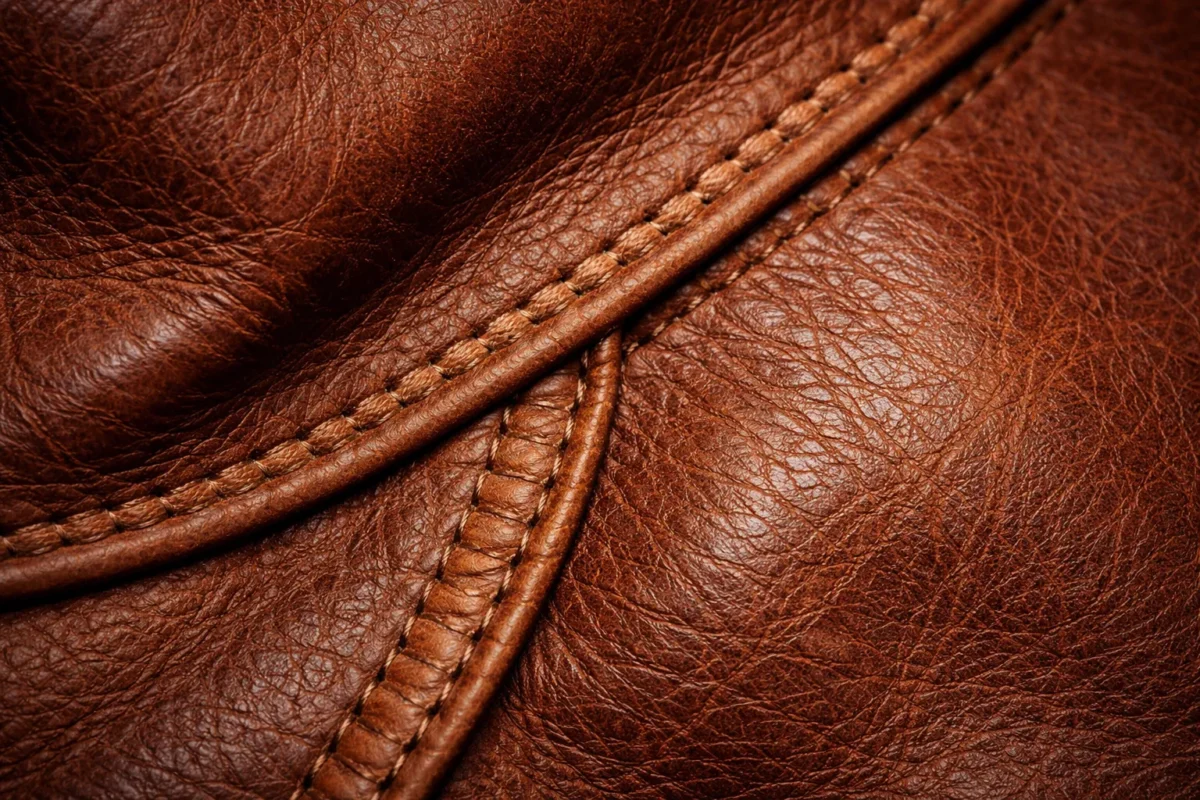
Look at the surface closely. Full-grain leather will show subtle variation. You might see small pores, tiny wrinkles, or slight tonal differences across the surface. That irregularity is the point. If the grain looks perfectly uniform and almost plastic-smooth, it has likely been corrected.
Check the edge. On genuine full-grain leather, the cut edge shows a solid, consistent cross-section. Split or bonded leather often reveals a fibrous, almost fabric-like interior.
Ask about the sourcing. A brand that uses full-grain leather will usually tell you so clearly. They will name the tannery, the hide type, and the finishing process. Vagueness about materials is often a warning sign.
Feel the surface. Full-grain leather has a natural warmth and slight give to it. Heavily treated or corrected leather often feels stiffer or slightly plasticky, especially around the edges.
Caring for Full-Grain Leather
Full-grain leather is durable, but it rewards a small amount of regular care.
Keep it away from prolonged direct sunlight, which can dry out and fade the surface over time. When the leather begins to look dry or slightly dull, apply a small amount of quality leather conditioner and work it in with a soft cloth. This restores the natural oils and keeps the fibres supple.
Wipe off water or spills promptly with a dry cloth. Full-grain leather handles moisture reasonably well, but standing water left to dry can leave marks. If the leather does get soaked, let it dry slowly at room temperature rather than using heat.
Store leather goods in a cool, dry place with some airflow. Sealed plastic bags trap moisture and can cause mildew over time.
Which Type of Leather Should You Choose?
If you want something that lasts, develops character, and rewards long-term ownership, full-grain leather is the only real answer.
Top-grain leather works well for buyers who prioritize a consistent, polished appearance and do not mind replacing the item in five to ten years. Split leather suits buyers on a tight budget who want the feel of real leather without the price. But for anyone who wants a product that actually improves with age, full-grain leather stands alone.
The investment is higher upfront. Over the course of a decade or more of use, it almost always pays for itself.
Conclusion
Full-grain leather is not a marketing term. It describes something specific and meaningful — a hide that has been kept intact, processed with respect for its natural qualities, and allowed to do what leather does best: endure, adapt, and improve with time.
When you buy full-grain leather, you are not just buying a product. You are investing in something that will carry your story forward with it. Every scratch, every crease, every deepened patch of colour adds up to something no factory finish can replicate.
Choose well, care for it properly, and a full-grain leather piece will likely outlast every other item in your wardrobe.
Frequently Asked Questions
What is full-grain leather and why is it considered the best?
Full-grain leather comes from the top layer of an animal hide and is not sanded or buffed to remove imperfections. This keeps the natural grain intact, making it the most durable and character-rich leather available. It develops a beautiful patina over time, which is why it consistently ranks as the highest quality option.
How can you tell if leather is full-grain or not?
Look for natural surface variation — small pores, slight wrinkles, and subtle tonal differences. Full-grain leather will never look perfectly uniform. Check the cut edges too. A solid, consistent cross-section points to genuine full-grain leather, while a fibrous interior often indicates split or bonded leather.
Does full-grain leather last longer than other types of leather?
Yes. Because the tight, dense grain layer remains untouched, full-grain leather resists wear far better than top-grain or split leather. With basic care, a full-grain leather jacket, bag, or pair of boots can last decades and actually improve in appearance as it ages.
Is full-grain leather worth the higher price?
For most buyers, yes. Full-grain leather products cost more upfront, but they last significantly longer and develop a rich patina that cheaper materials cannot replicate. When you factor in the years of use you get from a quality full-grain leather item, the cost per year of ownership is often lower than replacing a cheaper product every few years.

Grayscale Jacket Editorial Team is a group of fashion writers and product researchers who share guides, reviews, and styling tips about jackets and outerwear. Their goal is to help readers choose high-quality, stylish jackets while staying updated with the latest fashion trends.